Mismatch Repair (MMR) Status among Colorectal Cancer Patients in a Philippine Tertiary Hospital
A 4-Year Review
DOI:
https://doi.org/10.21141/PJP.2025.16Keywords:
biomarker, colorectal neoplasm, dMMR, DNA mismatch repairAbstract
Background. Approximately 15% of colorectal cancers exhibit deficient mismatch repair (dMMR) status, and these cases have a better prognosis and are less prone to metastasis. Moreover, dMMR is associated with an improved response to immune checkpoint inhibitors. Currently, local data on the MMR status of colorectal cancer patients remains scant.
Objective. The proponents aimed to determine the MMR status among colorectal cancer patients in a Philippine tertiary hospital.
Methodology. This is a descriptive cross-sectional study that included 42 patients with colorectal cancer seen at the Chinese General Hospital and Medical Center (CGHMC) from January 2021 to June 2024. Data was collected via retrospective review of histopathologic reports.
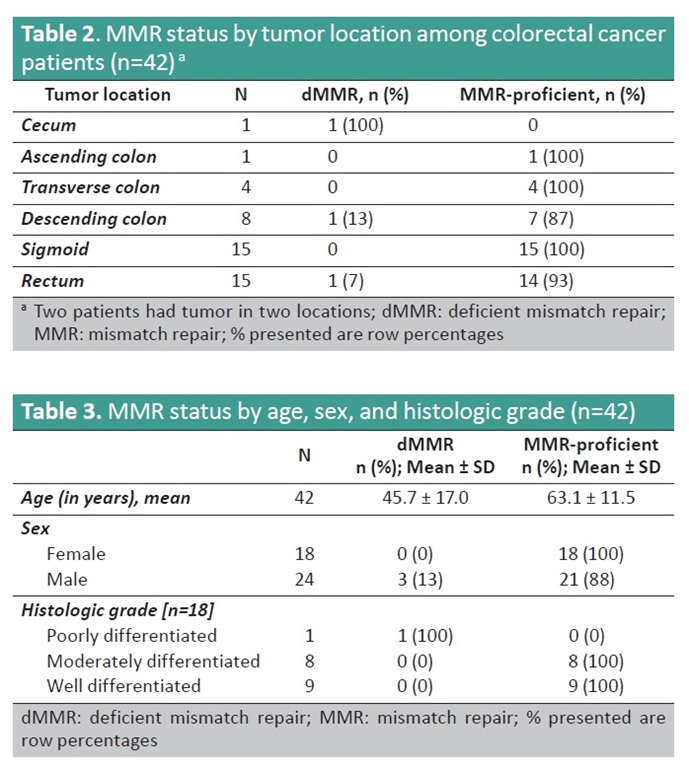
Results. Forty-two (42) patients were included in the study. The mean age of included patients was 61.8 years, and most were males. Half had well-differentiated tumor grade, and the most common tumor locations were rectum (38%) and sigmoid (36%). Three patients (7.14%; 95% CI:1.50-19.48%) were considered deficient. Tumor locations in dMMR patients were the cecum, descending colon, and rectum. Compared to MMR-proficient, dMMR patients had a lower mean age (63.1 vs. 45.7 years). Also, a higher proportion of males (13%) were dMMR than females (0%).
Conclusion. dMMR is uncommon among the colorectal cancer cases in this study, and was only seen at the cecum, descending colon, and rectum. Descriptive analysis revealed that patients with dMMR were younger than MMR-proficient patients. Moreover, a higher proportion of males were dMMR than females. Larger, multicenter studies are warranted to validate these preliminary findings and guide future clinical decision-making.
Downloads
References
WHO. Classification of tumors: digestive system tumors, 5th ed, vol. 1; 2019.
Taieb J, Svrcek M, Cohen R, et al. Deficient mismatch repair/microsatellite unstable colorectal cancer: Diagnosis, prognosis and treatment. Eur J Cancer. 2022;175:136–57. https://pubmed.ncbi.nlm.nih.gov/36115290 https://doi.org/10.1016/j.ejca.2022.07.020 DOI: https://doi.org/10.1016/j.ejca.2022.07.020
Jin Z, Sinicrope FA. Mismatch repair-deficient colorectal cancer: building on checkpoint blockade. J Clin Oncol. 2022;40(24):2735–50. https://pubmed.ncbi.nlm.nih.gov/5649217 https://pmc.ncbi.nlm.nih.gov/articles/PMC9390830 https://doi.org/10.1200/JCO.21.02691 DOI: https://doi.org/10.1200/JCO.21.02691
Kerr DJ, Midgley R. Defective mismatch repair in colon cancer: a prognostic or predictive biomarker? J Clin Oncol. 2010;28(20):3210–2. https://pubmed.ncbi.nlm.nih.gov/20498404 https://doi.org/10.1200/JCO.2010.28.9322 DOI: https://doi.org/10.1200/JCO.2010.28.9322
Rosenbaum MW, Bledsoe JR, Morales-Oyarvide V, Huynh TG, Mino-Kenudson M. PD-L1 expression in colorectal cancer is associated with microsatellite instability, BRAF mutation, medullary morphology and cytotoxic tumor-infiltrating lymphocytes. Mod Pathol. 2016;29(9):1104–12. https://pubmed.ncbi.nlm.nih.gov/27198569 https://doi.org/10.1038/modpathol.2016.95 DOI: https://doi.org/10.1038/modpathol.2016.95
Sacdalan DL, Garcia RL, Diwa MH, Sacdalan DB. Clinicopathologic factors associated with mismatch repair status among filipino patients with young-onset colorectal cancer. Cancer Manag Res. 2021;13:2105–15. https://pubmed.ncbi.nlm.nih.gov/33688253 https://pmc.ncbi.nlm.nih.gov/articles/PMC7936534 https://doi.org/10.2147/CMAR.S286618 DOI: https://doi.org/10.2147/CMAR.S286618
Buchler T. Microsatellite instability and metastatic colorectal cancer - a clinical perspective. Front Oncol. 2022;12:888181. https://pubmed.ncbi.nlm.nih.gov/35574322 https://pmc.ncbi.nlm.nih.gov/articles/PMC9097548 https://doi.org/10.3389/fonc.2022.888181 DOI: https://doi.org/10.3389/fonc.2022.888181
Kang YJ, O’Haire S, Franchini F, et al. A scoping review and meta-analysis on the prevalence of pan-tumour biomarkers (dMMR, MSI, high TMB) in different solid tumours. Sci Rep. 2022;12(1):20495. https://pubmed.ncbi.nlm.nih.gov/36443366 https://pmc.ncbi.nlm.nih.gov/articles/PMC9705554 https://doi.org/10.1038/s41598-022-23319-1 DOI: https://doi.org/10.1038/s41598-022-23319-1
Ueda K, Yamada T, Ohta R, et al. BRAF V600E mutations in right-side colon cancer: heterogeneity detected by liquid biopsy. Eur J Surg Oncol. 2022;48(6):1375–83. https://pubmed.ncbi.nlm.nih.gov/35172933 https://doi.org/10.1016/j.ejso.2022.01.016 DOI: https://doi.org/10.1016/j.ejso.2022.01.016
Rai PR, Shetty N, Rai PR, Shet D, Shetty A. A study on the frequency and clinicopathological correlates of mismatch repair-deficient colorectal cancer. J Cancer Res Ther. 2020;16(Suppl):S183–8. https://pubmed.ncbi.nlm.nih.gov/33380675 https://doi.org/10.4103/jcrt.JCRT_526_18 DOI: https://doi.org/10.4103/jcrt.JCRT_526_18
Spaander MCW, Zauber AG, Syngal S, et al. Young-onset colorectal cancer. Nat Rev Dis Prim. 2023;9(1):21. https://pubmed.ncbi.nlm.nih.gov/37105987 https://pmc.ncbi.nlm.nih.gov/articles/PMC10589420 https://doi.org/10.1038/s41572-023-00432-7 DOI: https://doi.org/10.1038/s41572-023-00432-7
Liang Y, Cai X, Zheng X, Yin H. Analysis of the clinicopathological characteristics of stage i-iii colorectal cancer patients deficient in mismatch repair proteins. Onco Targets Ther. 2021;14:2203-12. https://pubmed.ncbi.nlm.nih.gov/33814918 https://pmc.ncbi.nlm.nih.gov/articles/PMC8010427 https://doi.org/10.2147/OTT.S278029 DOI: https://doi.org/10.2147/OTT.S278029
Chen J, Zhou L, Gao J, et al. Clinicopathological characteristics and mutation spectrum of colorectal adenocarcinoma with mucinous component in a Chinese cohort: comparison with classical adenocarcinoma. Front Oncol. 2020;10:917. https://pubmed.ncbi.nlm.nih.gov/32582557 https://pmc.ncbi.nlm.nih.gov/articles/PMC7296099 https://doi.org/10.3389/fonc.2020.00917 DOI: https://doi.org/10.3389/fonc.2020.00917
Ooki A, Shinozaki E, Yamaguchi K. Immunotherapy in colorectal cancer: current and future strategies. J Anus Rectum Colon. 2021;5(1):11–24. https://pubmed.ncbi.nlm.nih.gov/33537496 https://pmc.ncbi.nlm.nih.gov/articles/PMC7843143 https://doi.org/10.23922/jarc.2020-064 DOI: https://doi.org/10.23922/jarc.2020-064
Downloads
Published
How to Cite
Issue
Section
License
Copyright (c) 2025 Rafael Anthon Nonato, Marissa Krizelda Santos

This work is licensed under a Creative Commons Attribution-NonCommercial-ShareAlike 4.0 International License.






 Educational mini-series for authors, reviewers, pathology residents, and researchers dedicated to improving scientific writing in pathology and laboratory medicine.


 @philippinepathologyjournal