SMARCB1 (INI-1)-deficient Sinonasal Carcinoma
A Case Report and its Clinical Implications on Diagnosis and Management
DOI:
https://doi.org/10.21141/PJP.2025.14Keywords:
SMARCB1-deficient Tumors, sinonasal carcinoma, poorly differentiated sinonasal carcinoma, undifferentiated sinonasal carcinomaAbstract
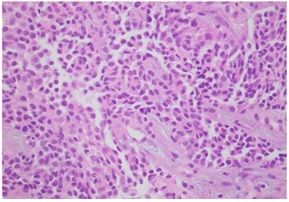
SMARCB1 (INI-1)-deficient sinonasal carcinoma is a rare, poorly differentiated, and locally aggressive neoplasm. Frequently, this disease entity mimics benign head and neck conditions, making diagnosis and management challenging. We report the case of a 66-year-old female who presented with a right nasal mass on endoscopy. Microscopy revealed well-defined nests of plasmacytoid tumor cells infiltrating a desmoplastic stroma, with areas of necrosis and focal hemorrhage. Based on the histomorphology and immunohistochemistry studies, the case was signed out as SMARCB1 (INI-1)-deficient sinonasal carcinoma. This is the first reported case in the Philippines based on a search of local journal databases. Recent advancements in therapeutics highlight the importance of providing molecular characterization of these tumors.
Downloads
References
Chung SY, Kenee P, Mitton T, Halderman A. SMARCB1(INI-1)-deficient sinonasal carcinoma: an evolving entity. J Neurol Surg Rep. 2023;84(1):e1-5. https://pubmed.ncbi.nlm.nih.gov/36712411 https://pmc.ncbi.nlm.nih.gov/articles/PMC9883109 https://doi.org/10.1055/a-1996-1283 DOI: https://doi.org/10.1055/a-1996-1283
Virk JS, Chan J, Dimitrov L, et al. Sinonasal cancer: an overview of the emerging subtypes. J Laryngol Otol. 2020;134(3):191-6. https://pubmed.ncbi.nlm.nih.gov/32160940 https://doi.org/10.1017/S0022215120000146 DOI: https://doi.org/10.1017/S0022215120000146
Mittal P, Roberts CWM. The SWI/SNF complex in cancer — biology, biomarkers and therapy. Nat Rev Clin Oncol. 2020;17(7):435-48. https://pubmed.ncbi.nlm.nih.gov/32303701 https://pmc.ncbi.nlm.nih.gov/articles/PMC8723792 https://doi.org/10.1038/s41571-020-0357-3 DOI: https://doi.org/10.1038/s41571-020-0357-3
Cooper GW, Hong AL. SMARCB1-deficient cancers: novel molecular insights and therapeutic vulnerabilities. Cancers (Basel). 2022;14(15):3645. https://pubmed.ncbi.nlm.nih.gov/35892904 https://pmc.ncbi.nlm.nih.gov/articles/PMC9332782 https://doi.org/10.3390/cancers14153645 DOI: https://doi.org/10.3390/cancers14153645
Parker NA, Al-Obaidi A, Deutsch, JM. SMARCB1/INI1-deficient tumors of adulthood. F1000Res. 2020;9:662. https://pubmed.ncbi.nlm.nih.gov/33796273 https://pmc.ncbi.nlm.nih.gov/articles/PMC7968524 https://doi.org/10.12688/f1000research.24808.2 DOI: https://doi.org/10.12688/f1000research.24808.1
Alsayed AM, Aljufairi EA, Alshammari AO, Alsindi KA, Sabra OA. NI-1-Deficient sinonasal carcinoma: case report with emphasis on differential diagnosis. Case Rep Pathol. 2022:2022:5629984. https://pubmed.ncbi.nlm.nih.gov/35399302 https://pmc.ncbi.nlm.nih.gov/articles/PMC8986412 https://doi.org/10.1155/2022/5629984 DOI: https://doi.org/10.1155/2022/5629984
Custers L, Khabirova E, Coorens THH, et al. Somatic mutations and single-cell transcriptomes reveal the root of malignant rhabdoid tumours. Nat Commun. 2021;12(1):1407. https://pubmed.ncbi.nlm.nih.gov/33658498 https://pmc.ncbi.nlm.nih.gov/articles/PMC7930245 https://doi.org/10.1038/s41467-021-21675-6 DOI: https://doi.org/10.1038/s41467-021-21675-6
Agaimy A, Hartmann A, Antonescu CR, et al. SMARCB1 (INI-1)-deficient sinonasal carcinoma: a series of 39 cases expanding the morphologic and clinicopathologic spectrum of a recently described entity. Am J Surg Pathol. 2017;41(4):458-71. https://pubmed.ncbi.nlm.nih.gov/28291122 https://pmc.ncbi.nlm.nih.gov/articles/PMC5354087 https://doi.org/10.1097/PAS.0000000000000797 DOI: https://doi.org/10.1097/PAS.0000000000000797
Kakkar A, Antony VM, Pramanik R, Sakthivel P, Singh CA, Jain D. SMARCB1 (INI1)–deficient sinonasal carcinoma: a series of 13 cases with assessment of histologic patterns. Hum Pathol. 2019:83:59-67. https://pubmed.ncbi.nlm.nih.gov/30120966 https://doi.org/10.1016/j.humpath.2018.08.008 DOI: https://doi.org/10.1016/j.humpath.2018.08.008
WHO Classification of Tumours Editorial Board. Head and neck tumours. Lyon, France: International Agency for Research on Cancer; 2022. WHO classification of tumours series. 5th ed. Vol. 9. Beta version ahead of print. https://tumourclassification.iarc.who.int/chapters/52
Ou C, Ho SP. SMARCB1 (INI1)-deficient sinonasal carcinoma, basaloid subtype: first reported case in Taiwan and literature review. Hum Pathol: Case Rep. 2020:200423. https://doi.org/10.1016/j.ehpc.2020.200423 DOI: https://doi.org/10.1016/j.ehpc.2020.200423
Chitguppi C, Rabinowitz MR, Johnson J, et al. Loss of SMARCB1 expression confers poor prognosis to sinonasal undifferentiated carcinoma. J Neurol Surg B Skull Base. 2020;81(6):610-9. https://pubmed.ncbi.nlm.nih.gov/33381364 https://pmc.ncbi.nlm.nih.gov/articles/PMC7755502 https://doi.org/10.1055/s-0039-1693659 DOI: https://doi.org/10.1055/s-0039-1693659
Takahashi Y, Hanna EY. Molecular characterization of sinonasal undifferentiated carcinoma—past, present, and future. Eur J Rhinol Allergy. 2023;6(2):37-41. https://mdanderson.elsevierpure.com/en/publications/molecular-characterization-of-sinonasal-undifferentiated-carcinom/
Shaverdashvili K, Azimi-Nekoo E, Cohen P, et al. Sinonasal carcinoma: novel paradigm of molecular testing in the diagnosis and management of sinonasal malignancies. Oncologist. 2020; 25(9):738-44. https://pubmed.ncbi.nlm.nih.gov/32337786 https://pmc.ncbi.nlm.nih.gov/articles/PMC7485347 https://doi.org/10.1634/theoncologist.2019-0830 DOI: https://doi.org/10.1634/theoncologist.2019-0830
Zhao, S, Du, H, Zhang, Z, et al. SMARCB1/INI-1-Deficient sinonasal carcinoma demonstrates a poor prognosis but favorable clinical outcomes after PD-1/PD-L1 inhibitor therapy: a case series. Sci Prog. 2025;108(1):368504251315075. https://pubmed.ncbi.nlm.nih.gov/39886754 https://pmc.ncbi.nlm.nih.gov/articles/PMC11783480 https://doi.org/10.1177/00368504251315075 DOI: https://doi.org/10.1177/00368504251315075
Kalimuthu SN, Chetty R. Gene of the month: SMARCB1. J Clin Pathol. 2016;69(6):484-9. MID: 26941181 https://pmc.ncbi.nlm.nih.gov/articles/PMC4914571 https://doi.org/10.1136/jclinpath-2016-203650 DOI: https://doi.org/10.1136/jclinpath-2016-203650
Downloads
Published
How to Cite
Issue
Section
License
Copyright (c) 2025 Dianne Mae Tan, Glezette Anne Altares, Rose Lou Marie Agbay, Jose Carnate Jr.

This work is licensed under a Creative Commons Attribution-NonCommercial-ShareAlike 4.0 International License.






 Educational mini-series for authors, reviewers, pathology residents, and researchers dedicated to improving scientific writing in pathology and laboratory medicine.


 @philippinepathologyjournal